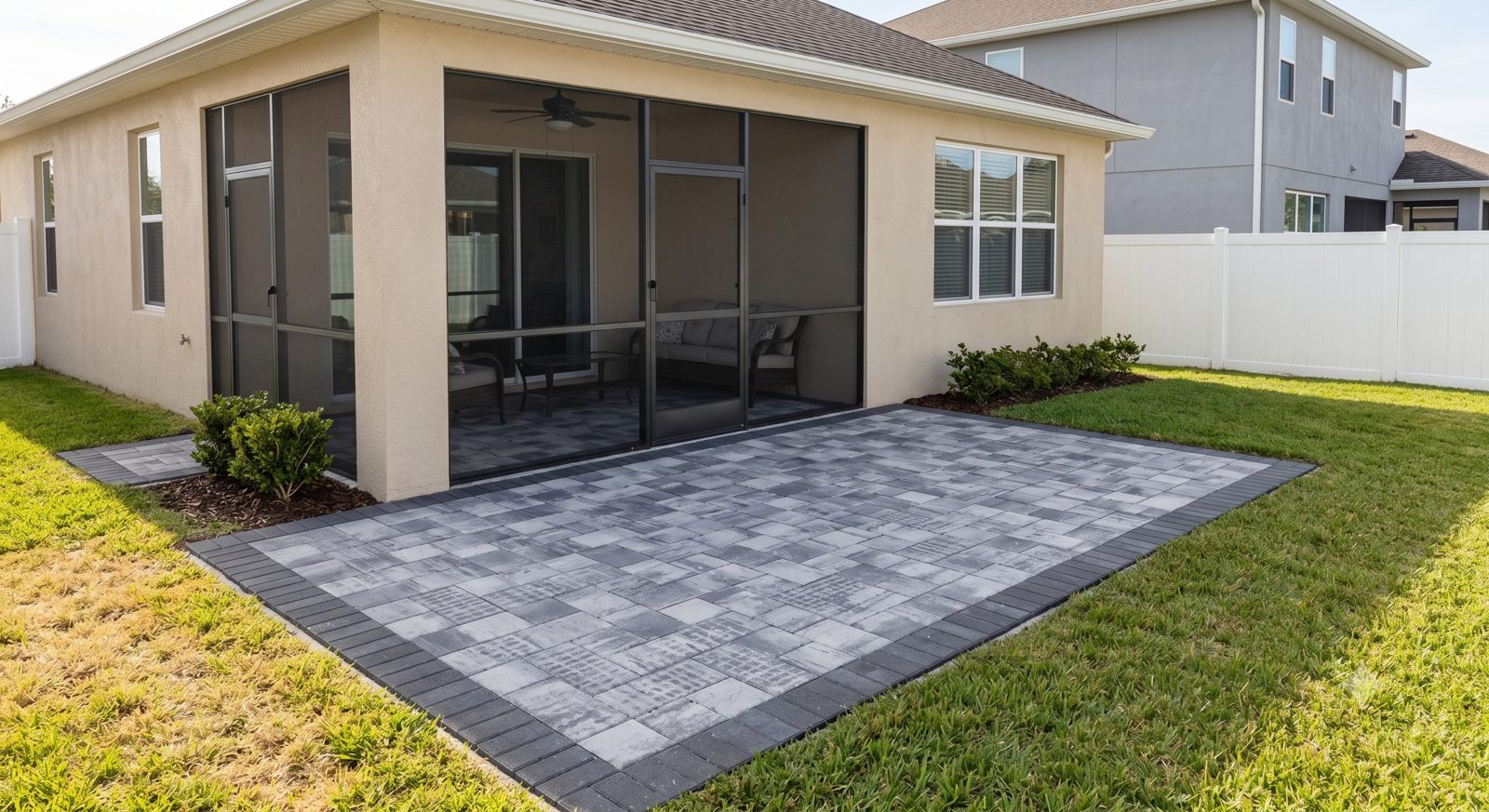
- On-site measure of the full pour or paver footprint
- Soil and subgrade condition assessed for sand, muck, or fill
- Drainage and slope direction mapped away from the home
- Existing slab, driveway, or deck inspected for tie-in points
- Utility, irrigation, and sprinkler lines located and flagged
- HOA / ARC color, paver, and finish restrictions reviewed
- Access path for trucks, mixers, and equipment confirmed
Manatee County · Paver Patios & Walkways · 15+ neighborhoods
Paver Patios & Walkways
Paver Patios & Walkways
in Palmetto, FL.
Paver patios, walkways, pool decks, fire pits, and steps — from tight running-bond paths to wide gravel-joint patios, set on a compacted base and built to stay flat and cool underfoot.
15+ Palmetto neighborhoods
Fully Insured
42-point install standard
Written workmanship warranty
01
Paver Patios & Walkways in Palmetto, Florida is one of our most-requested services across Manatee County. Palmetto — historic riverfront city across the Manatee River from Bradenton, 13,500 residents. 1950s–70s waterfront homes get poured driveways and paver walkways; Artisan Lakes and Trevesta along US-301 drive new-construction paver upgrades. The paver patios & walkways market in Palmetto is shaped by three things: paver driveways and pool decks in artisan lakes new builds plus poured-concrete restoration work on the waterfront, the sandy soil and year-round humidity we share across Lakewood Ranch, Manatee & Sarasota, and the volume of new construction (and aging concrete) in the neighborhoods we work here.
A patio or walkway gets walked, lounged, and entertained on barefoot, so the things that matter here are different from a driveway: comfort, drainage, and a surface that stays put. Under the Gulf Coast sun, paver color and texture decide how the deck feels — lighter tumbled tones near a pool run far cooler underfoot than a dark slab, and we’ll steer you toward units that don’t bake. Florida’s sandy soil still needs a real compacted base; a patio set straight on raw sand telegraphs every settled spot and rocks under a chair leg within a season. We grade every surface to shed water away from the house and screen cage, because standing water is what feeds mildew, undermines pavers, and ruins a lanai. We lock joints against weeds and ants, and in HOA / ARC-governed Lakewood Ranch villages we match the approved hardscape palette so your project clears review. Every install follows our Lakewood Ranch Concrete 42-Point Install Standard, and we offer free estimates and financing so the patio you actually want isn’t the one you talk yourself out of.
This service covers the full outdoor-living kit — patios, walkways, pool decks, spaced gravel-joint paver patios, paver fire pits, and paver steps. We set brick, concrete, and permeable pavers; large-format and plank units read modern, tumbled units read old-world, and a gravel or grass joint between widely-spaced pavers gives a soft, garden look that also drains hard. Foot-traffic areas are lighter than a driveway — typically 30–50 mm pavers over a compacted base around 4–6″ deep — but the discipline is identical: screeded bedding sand, true lines, and an edge restraint locked along every open edge so the field never creeps. Fire pits and steps are built with wall-block and capstones rated for the job and seated on a stable footing. We finish joints with polymeric sand (or gravel where the design calls for it) and talk through sealing honestly — it deepens color and fights stains, but it’s an upkeep choice, not a requirement.
The local angle for Palmetto: Waterfront and Snead Island slabs face salt-air exposure, so we use proper concrete cover, sealed pavers, and full curing to resist surface scaling and efflorescence near the river. For paver patios & walkways specifically, that means we excavate and compact the base to depth, plan control and expansion joints for how this ground moves, and confirm drainage before anything is poured or laid. Most Palmetto projects we take on are in Historic Downtown Palmetto, Riviera Dunes, or one of the surrounding subdivisions — we’ve worked all of them, we know the HOA / ARC rules, and we know what Manatee County permitting actually looks for when a permit is involved.
03
- ●Paver patios (brick, concrete & permeable)
- ●Paver walkways & garden paths
- ●Paver pool decks & lanai surfaces
- ●Spaced gravel-joint & grass-joint patios
- ●Paver fire pits with rated wall-block & cap
- ●Paver steps & stair landings
- ●Large-format & plank paver layouts
- ●Compacted crushed-limerock base in lifts
- ●Screeded bedding-sand setting bed
- ●Drainage pitch away from house & screen cage
- ●Concrete & spiked edge restraints
- ●Polymeric-sand & gravel joint finishing
- ●Soldier-course & contrasting borders
- ●Paver sealing (penetrating & wet-look options)
- ●Old slab or paver removal & haul-away
04
- Existing surface demoed and hauled off as scoped
- Subgrade excavated to design depth for slab or paver base
- Soft or organic soil cut out and replaced with clean fill
- Compactable base (crushed limerock / road base) brought in
- Base compacted in lifts with a plate compactor to spec
- Final grade and slope re-checked for positive drainage
- Edge lines, depth, and pad dimensions verified before forming
- Forms set, staked, and leveled to the planned slope
- Fiber mesh and / or rebar / wire reinforcement placed
- Rebar chaired up off the base so it sits inside the slab
- Control-joint and expansion-joint layout planned
- Thickened edges formed where load demands it
- Vapor barrier installed under interior-adjacent slabs
- Forms and reinforcement photographed before the pour
- Concrete mix and PSI confirmed for the application
- Pour placed, screeded, and floated to grade
- Specified finish applied — broom, stamp, or smooth
- Color, release, or stain applied per the approved sample
- Pavers laid to pattern on a screeded sand setting bed
- Edge restraints installed to lock the paver field
- Soldier course / borders set straight and consistent
- Control joints cut or tooled at engineered spacing
- Expansion joints set against the house and fixed structures
- Curing compound or wet-cure applied to the fresh slab
- Pavers compacted into the bed with a plate compactor
- Polymeric joint sand swept in, compacted, and activated
- Slab and paver edges cleaned of slurry and excess sand
- Cure / set time communicated before foot or vehicle traffic
- Site cleaned, forms pulled, and debris hauled away
- Surface pressure-washed and inspected when sealing is scoped
- Sealer applied evenly at the correct cure window
- Final slope and drainage confirmed with a hose test
- Walkthrough with the homeowner — full surface inspected
- Care, curing, and maintenance guidance handed over
- Written workmanship warranty issued and job photos sent
05
Historic Downtown Palmetto
Riviera Dunes
Snead Island
Terra Ceia
Sanctuary Cove
Heron Creek
Esplanade at Artisan Lakes
Artisan Lakes
Trevesta
Northshore at Riviera Dunes
Rye Wilderness Estates
Palmetto Estates
Palm View
Memphis
Ellenton
06
01
Rushing the base on a patio or walkway.
Sunken, wobbly, tripping-hazard pavers come from a skipped base. Even a walkway needs an excavated, compacted base and a screeded bedding layer before pavers are set. We compact in lifts and screed the bed flat so the finished surface is even and stays that way — not a patchwork of high and low pavers a season later.
02
Forgetting the slope away from the house.
A paver patio still has to shed water away from the home and the lanai. Laid dead-flat or sloped the wrong way, it sends rainwater toward the foundation. We set the bedding and field to a deliberate fall away from the structure so water runs off where it should, not back against the house.
03
Leaving out edge restraints on the open sides.
Patios and walkways spread at any unrestrained edge — the open sides creep, joints open, and the border pavers wander. We install edge restraints along every open edge to lock the field, so the clean lines you paid for stay clean.
04
Using plain sand that washes out of the joints.
Joint sand that isn’t polymeric washes out in Florida downpours, and then come the weeds, the ants, and the rocking pavers. We sweep in polymeric joint sand, compact it, and activate it so the joints stay locked and the surface stays solid and low-maintenance.
05
Treating the layout as an afterthought.
A walkway that doesn’t line up with the door, or a patio pattern that fights the shape of the space, reads as cheap no matter how good the pavers are. We plan the pattern, borders, and transitions to the home and the layout so the finished hardscape looks designed, not just installed.
2026 Paver Patios & Walkways pricing for Palmetto homes.
| Option | What it’s best for | Installed cost |
|---|---|---|
| Concrete Paver Patio / Walkway | Most-installed foot-traffic tier | $14–$20/sq ft installed |
| Brick (Clay) Paver Patio | Color-fast, classic look | $17–$24/sq ft installed |
| Premium / Large-Format Paver | Plank & oversized units | $19–$27/sq ft installed |
| Spaced Gravel-Joint Paver Patio | Open joints, soft garden look | $18–$26/sq ft installed |
| Permeable Paver Patio / Deck | Drains through the surface | $20–$28/sq ft installed |
| Paver Fire Pit (built-in) | Rated wall-block & capstone | $1,400–$3,800 each |
| Paver Steps (per riser) | Seated on stable footing | $300–$650 each |
| Paver Sealing | Penetrating or wet-look film | $1–$2.50/sq ft |
Prices include labor, base prep, and standard finishing. Old-surface demo & haul-away quoted per job. Financing available on larger projects. Free written estimate within 24 hrs →
07
07
Will a paver pool deck stay cool enough to walk on?
Cooler than a dark slab, and the choice of paver is what decides it. Under full Gulf Coast sun, color and texture drive surface temperature far more than material does — a light, tumbled concrete or clay paver near a pool stays noticeably more comfortable underfoot than a dark, dense unit that soaks up heat all afternoon. Pavers also have an edge over poured concrete here because the jointed field doesn’t hold and radiate heat in one unbroken sheet. We steer pool-deck clients toward lighter tones and textured finishes for exactly this reason, and we can show you samples in your own light. If barefoot comfort is the priority, tell us up front — it genuinely changes which paver we recommend.
What’s a gravel-joint or spaced paver patio?
It’s a patio where the pavers are set with a deliberate gap between them — an inch or more — and that gap is filled with fine gravel or planted with a low ground cover instead of tight sand. The look is softer and more organic, a great fit for garden patios and modern large-format layouts. The practical bonus in Florida is drainage: those open joints let rain pass straight down instead of sheeting across the surface, which is why we like them on lots that pond. They do trade a little: gravel joints need occasional topping up and aren’t ideal under narrow heels or chair casters. We’ll tell you honestly whether the spaced look suits how you’ll actually use the space.
Can you build a fire pit and steps into the patio?
Yes — built-in paver fire pits and paver steps are part of this service and a natural extension of a patio project. We build fire pits from wall-block and capstones rated for heat, seated on a stable, compacted footing so the ring stays true and level for years, and we’ll set it up for wood or pipe it for gas depending on what you want. Steps and stair landings are built on their own solid footing with the same paver field as the patio so everything reads as one surface. What we don’t do is structural or tall retaining work — we keep to hardscape walls under four feet. If your layout needs grade changes, we’ll lay out exactly what fits within that.
How long do paver patios last, and what upkeep is there?
A properly based paver patio is a multi-decade surface — the pavers themselves outlast almost everything else in the yard, and the field is fully repairable, so a settled or stained paver gets lifted and reset rather than patched. The upkeep is light and predictable: an occasional rinse or gentle pressure-wash, a top-up of polymeric joint sand every several years as sun and washing wear it, and a gravel-joint refresh if you went that route. Sealing is optional — it deepens color and helps shed stains on a patio that hosts a lot of food and drink, but it’s an upkeep cycle you opt into, not a requirement. We’re fully insured, estimates are free, and we’ll lay out the realistic maintenance before you commit.
Free Estimate · No Pressure
Ready for a real estimate on paver patios in Palmetto?
Free on-site measure. Written estimate within 24 hours. Paver Patios for Palmetto homes, built to the 42-point Lakewood Ranch Concrete standard — Fully Insured.
(941) 263-0948