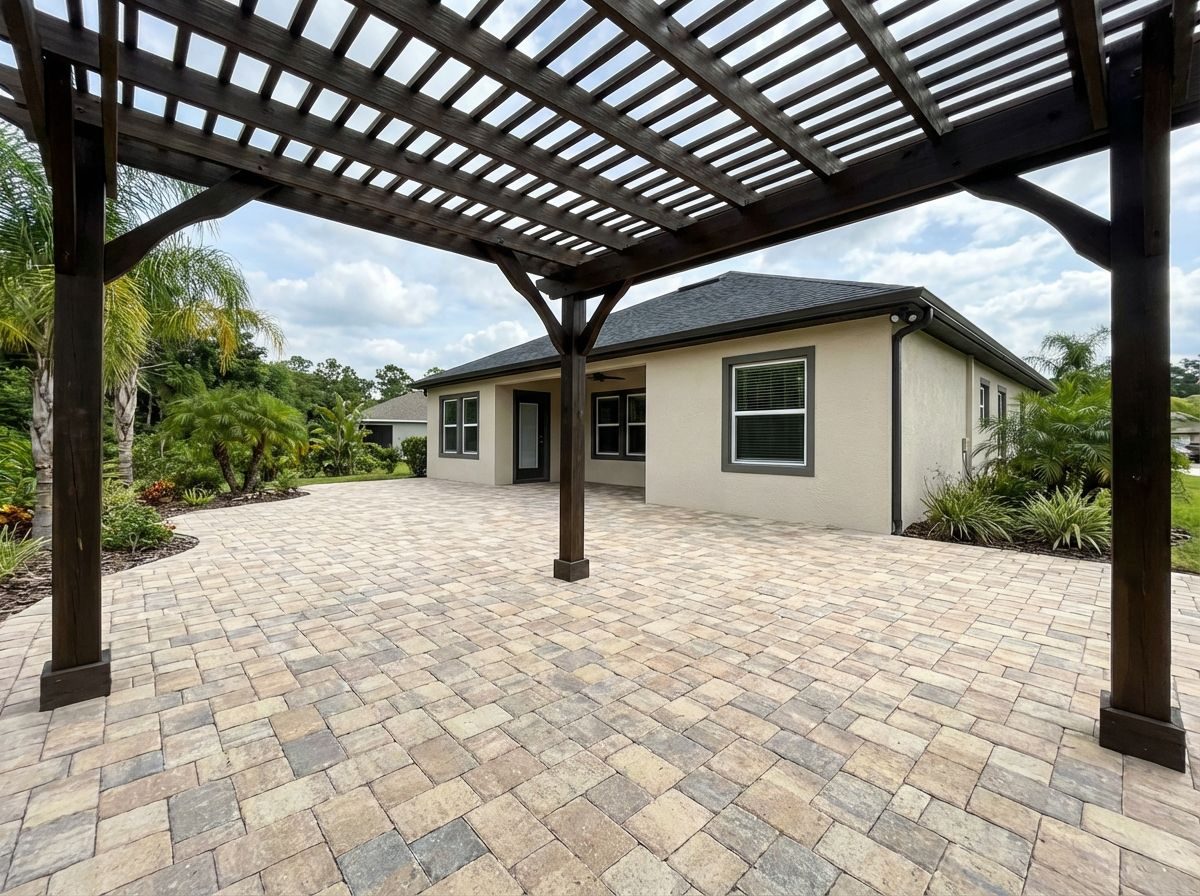
- On-site measure of the full pour or paver footprint
- Soil and subgrade condition assessed for sand, muck, or fill
- Drainage and slope direction mapped away from the home
- Existing slab, driveway, or deck inspected for tie-in points
- Utility, irrigation, and sprinkler lines located and flagged
- HOA / ARC color, paver, and finish restrictions reviewed
- Access path for trucks, mixers, and equipment confirmed
Manatee County · Pool Deck Pavers & Travertine · 15+ neighborhoods
Pool Deck Pavers & Travertine
Pool Deck Pavers & Travertine
in Ellenton, FL.
Travertine, brick, and concrete pavers laid around your pool — cool underfoot in July, set on a compacted base that holds true through our sandy soil and summer storms.
15+ Ellenton neighborhoods
Fully Insured
42-point install standard
Written workmanship warranty
01
Pool Deck Pavers & Travertine in Ellenton, Florida is one of our most-requested services across Manatee County. Ellenton — small Manatee County community near the Ellenton Premium Outlets and Gamble Plantation. Covered Bridge, Bougainvillea Place, and nearby North River neighborhoods drive paver driveway and pool-deck upgrades plus poured-concrete patio work. The pool deck pavers & travertine market in Ellenton is shaped by three things: paver driveways and pool decks in master-planned neighborhoods plus poured-concrete flatwork in established sections, the sandy soil and year-round humidity we share across Lakewood Ranch, Manatee & Sarasota, and the volume of new construction (and aging concrete) in the neighborhoods we work here.
A pool deck is the one surface in a Lakewood Ranch backyard that gets walked on barefoot, wet, in the middle of a Florida afternoon — and that is exactly where a poured concrete or dark-paver deck fails the people using it. Surface temperature is the whole conversation, and we have it honestly before we quote a single square foot. Light-toned travertine and ivory concrete pavers can run twenty to thirty degrees cooler than broom-finished concrete in direct sun, which is the difference between a deck your kids run across and one nobody touches without sandals. The second conversation is the base. Our sandy, fast-draining soil and the salt-and-chlorine splash off the pool will heave and stain a deck that was set on a lazy base, so every install follows the Lakewood Ranch Concrete 42-Point Install Standard — compacted limerock, proper slope away from the coping, and a bedding layer that drains instead of trapping water against your home. In an ARC-governed neighborhood like Country Club East or Esplanade, we also pull the approved color and pattern list before you fall in love with a paver the board will reject. Estimates are free and financing is available so the deck gets built once, right.
We build pool decks on three materials and we will tell you which one actually earns its price in your yard. Travertine is the premium pick — a natural stone that stays remarkably cool, wears a honed, slip-friendly face, and reads high-end against screen enclosures and spillover spas; its only honest caveat is that it is porous and wants sealing against salt and chlorine. Concrete pavers are the volume choice: dense, dimensionally consistent, available in tumbled and smooth faces, and easy to lift-and-reset if a tree root or settle ever shows up. Clay brick pavers hold their color for decades and suit a traditional elevation. Whatever the face, the joints get filled with polymeric sand — not loose mason sand — so ants, weeds, and pressure-washing do not empty them out by the next season. We set the perimeter and any spillover edges first, run the field to the drains, and finish with a bond beam or restraint edge so the deck cannot creep apart at the very pivot points that take the most foot traffic.
The local angle for Ellenton: Ellenton’s sandy soils near the Manatee River shift with seasonal moisture, so compacted sub-base and properly spaced control joints are essential to prevent driveway and slab cracking. For pool deck pavers & travertine specifically, that means we excavate and compact the base to depth, plan control and expansion joints for how this ground moves, and confirm drainage before anything is poured or laid. Most Ellenton projects we take on are in Covered Bridge Estates, Bougainvillea Place, or one of the surrounding subdivisions — we’ve worked all of them, we know the HOA / ARC rules, and we know what Manatee County permitting actually looks for when a permit is involved.
03
- ●Travertine pool deck installation (honed, slip-friendly face)
- ●Concrete paver pool decks (tumbled & smooth)
- ●Clay brick paver pool decks
- ●Pool coping & bullnose edge work
- ●Spillover spa & raised-bond-beam paver detailing
- ●Compacted limerock base to the 42-Point Standard
- ●Proper slope & drainage away from coping & home
- ●Paver-over-existing-concrete overlay where slab is sound
- ●Screen-enclosure & cage-footer tie-in
- ●Polymeric sand joint filling
- ●Edge restraint & perimeter bond beam
- ●Paver banding & border accent patterns
- ●ARC / HOA color & pattern submittal prep
- ●Penetrating sealer application on travertine & pavers
- ●Site cleanup & haul-away of demo material
04
- Existing surface demoed and hauled off as scoped
- Subgrade excavated to design depth for slab or paver base
- Soft or organic soil cut out and replaced with clean fill
- Compactable base (crushed limerock / road base) brought in
- Base compacted in lifts with a plate compactor to spec
- Final grade and slope re-checked for positive drainage
- Edge lines, depth, and pad dimensions verified before forming
- Forms set, staked, and leveled to the planned slope
- Fiber mesh and / or rebar / wire reinforcement placed
- Rebar chaired up off the base so it sits inside the slab
- Control-joint and expansion-joint layout planned
- Thickened edges formed where load demands it
- Vapor barrier installed under interior-adjacent slabs
- Forms and reinforcement photographed before the pour
- Concrete mix and PSI confirmed for the application
- Pour placed, screeded, and floated to grade
- Specified finish applied — broom, stamp, or smooth
- Color, release, or stain applied per the approved sample
- Pavers laid to pattern on a screeded sand setting bed
- Edge restraints installed to lock the paver field
- Soldier course / borders set straight and consistent
- Control joints cut or tooled at engineered spacing
- Expansion joints set against the house and fixed structures
- Curing compound or wet-cure applied to the fresh slab
- Pavers compacted into the bed with a plate compactor
- Polymeric joint sand swept in, compacted, and activated
- Slab and paver edges cleaned of slurry and excess sand
- Cure / set time communicated before foot or vehicle traffic
- Site cleaned, forms pulled, and debris hauled away
- Surface pressure-washed and inspected when sealing is scoped
- Sealer applied evenly at the correct cure window
- Final slope and drainage confirmed with a hose test
- Walkthrough with the homeowner — full surface inspected
- Care, curing, and maintenance guidance handed over
- Written workmanship warranty issued and job photos sent
05
Covered Bridge Estates
Bougainvillea Place
North River
Foxbrook
Old Mill
Oak Run
Magnolia Manor
Ellenton Gardens
Willow Walk
Gillette
Hidden Oaks
Northwood Park
River Place at Ellenton
Sugar Mill Lakes
Terra Ceia Village
06
01
Skipping the compacted base around the pool.
A paver pool deck on a rushed base settles unevenly right where people walk barefoot and dripping — the worst place for a tripping lip. We excavate and compact a proper base and bedding layer in lifts before setting pavers, so the deck stays flat and even around the entire pool for the long haul.
02
Draining water back toward the pool and cage.
A pool deck has to fall away from the coping and toward the deck drains, or splash-out and rain pool at the water’s edge and attack the coping and cage footers. We set the paver field to a deliberate slope away from the pool and hose-test it before handover.
03
Choosing a paver that bakes in the sun.
Some pavers hold heat and cook bare feet around a pool. Travertine and lighter-colored pavers stay markedly cooler underfoot — a real difference on a July afternoon. We steer pool-deck clients toward cooler, slip-resistant materials made for wet, barefoot traffic.
04
Leaving the joints with plain, washout-prone sand.
Around a pool, joint sand faces constant splash-out and rain. Plain sand washes out fast, the joints empty, and pavers loosen. Polymeric joint sand — compacted and activated — holds the field together against all that water and keeps the deck tight and weed-free.
05
Setting pavers tight to the coping with no isolation.
The pool shell, deck, and cage all move at different rates. Pavers crowded against the coping with no allowance for that movement loosen and lift at the bond beam. We detail the deck-to-coping transition properly so the field moves with the structure instead of fighting it.
2026 Pool Deck Pavers & Travertine pricing for Ellenton homes.
| Option | What it’s best for | Installed cost |
|---|---|---|
| Concrete Paver Pool Deck | Tumbled or smooth, on new compacted base | $16–$24/sq ft installed |
| Travertine Pool Deck | Premium cool-touch natural stone | $22–$32/sq ft installed |
| Clay Brick Paver Deck | Color-fast, traditional elevation | $18–$26/sq ft installed |
| Paver Overlay on Sound Concrete | When existing slab passes inspection | $14–$20/sq ft |
| Pool Coping (per linear ft) | Bullnose or square edge to match | $28–$48/lin ft |
| Spillover / Raised Bond Beam | Spa & planter edge detailing | $45–$85/lin ft |
| Old Deck Demo & Haul | Tear-out of broken concrete or pavers | $3–$6/sq ft |
| Penetrating Sealer (at install) | Salt & chlorine protection, breathable | $1.25–$2.50/sq ft |
Prices include labor, base prep, and standard finishing. Old-surface demo & haul-away quoted per job. Financing available on larger projects. Free written estimate within 24 hrs →
07
07
Does travertine really stay cool enough for bare feet?
Yes — and it is the main reason we install so much of it around Lakewood Ranch pools. Light, ivory-toned travertine reflects sun rather than absorbing it, so in a direct July afternoon it commonly runs twenty to thirty degrees cooler than broom-finished concrete or a dark paver. It will never be cold, and no surface in full Florida sun is truly cool at 2 p.m., but the difference between travertine and standard concrete is the difference between walking across comfortably and hopping. Color matters as much as the material: a pale travertine or ivory concrete paver stays usable, a charcoal paver does not. We will show you actual samples in your own sun before you choose.
How often does a paver or travertine pool deck need sealing?
Plan on resealing every two to three years, and travertine on the shorter end because it is naturally porous. The pool environment is hard on any deck — chlorine, salt spray, sunscreen, and constant wet-dry cycling all pull at the surface and the joints. A breathable penetrating sealer soaks in, repels salt and stains, and helps lock the polymeric sand without leaving a slick film. We do not recommend a glossy film-forming sealer on a wet pool deck because it can get slippery; the honest call here is a matte penetrating product. If your deck still beads water and the joints are full, you can wait; once it darkens when wet or the sand washes low, it is time.
What keeps weeds and ants out of the joints?
Polymeric sand — and it is non-negotiable on our installs. Ordinary mason sand washes out under rain and pressure-washing, and the open joints then invite weeds, ants, and shifting pavers. Polymeric sand is swept into the joints and activated with a light mist so it firms up into a flexible, locked binder that resists washout, weeds, and insects while still letting the deck breathe and drain. Around a pool, where the deck gets soaked daily and cleaned often, this is what keeps the surface tight for years instead of months. When it eventually wears low, it is re-swept and re-activated — not torn out — which is part of our paver restoration service.
Is a paver pool deck slippery when wet?
Less than you would expect, when it is built right. Pavers and tumbled travertine have a textured, honed face and the joint lines themselves break up sheeting water, so they grip better wet than a smooth troweled-concrete deck. The two things that actually create a slip risk are the wrong sealer — a glossy film-forming product over a constantly wet surface — and standing water from a deck that was never sloped to drain. We handle both at install: a matte penetrating sealer that does not change the traction, and a base graded to carry water off the deck and away from your coping and home rather than letting it pool where people walk.
Free Estimate · No Pressure
Ready for a real estimate on pool deck pavers in Ellenton?
Free on-site measure. Written estimate within 24 hours. Pool Deck Pavers for Ellenton homes, built to the 42-point Lakewood Ranch Concrete standard — Fully Insured.
(941) 263-0948