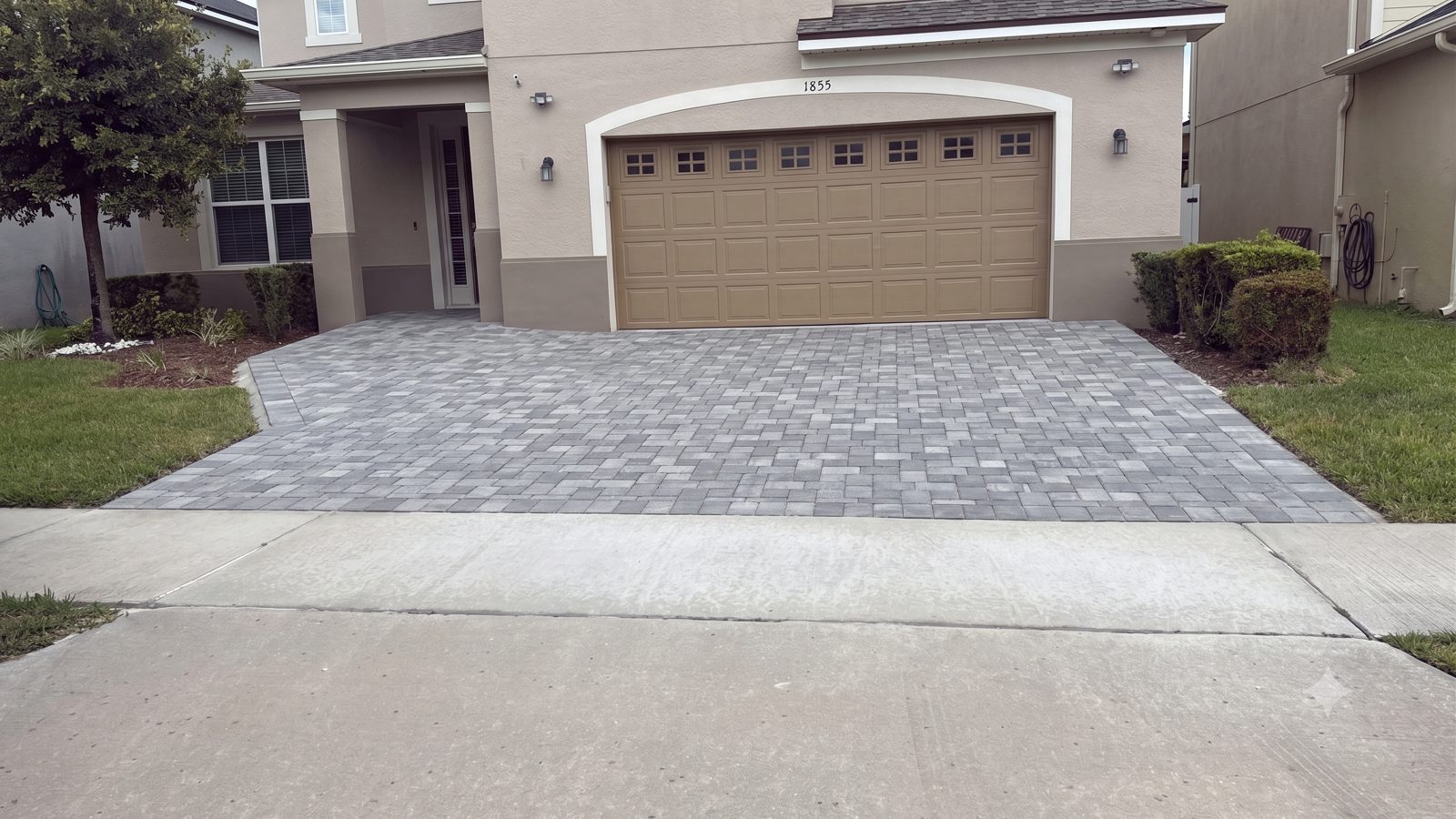
- On-site measure of the full pour or paver footprint
- Soil and subgrade condition assessed for sand, muck, or fill
- Drainage and slope direction mapped away from the home
- Existing slab, driveway, or deck inspected for tie-in points
- Utility, irrigation, and sprinkler lines located and flagged
- HOA / ARC color, paver, and finish restrictions reviewed
- Access path for trucks, mixers, and equipment confirmed
Sarasota County · Paver Driveways · 17+ neighborhoods
Paver Driveways
Paver Driveways
in North Port, FL.
Interlocking brick and concrete paver driveways — engineered base, sand-set field, and locked joints built to carry Florida vehicle loads without rutting, settling, or washing out.
17+ North Port neighborhoods
Fully Insured
42-point install standard
Written workmanship warranty
01
Paver Driveways in North Port, Florida is one of our most-requested services across Sarasota County. North Port — Sarasota County. 85,000+ residents and climbing fast. Wellen Park / West Villages new-construction pool decks and paver lanais, plus heavy driveway repour work across the older Price Boulevard and Toledo Blade lot grid. The paver driveways market in North Port is shaped by three things: wellen park new-construction pool decks and pavers plus driveway repours across the older platted-lot grid, the sandy soil and year-round humidity we share across Lakewood Ranch, Manatee & Sarasota, and the volume of new construction (and aging concrete) in the neighborhoods we work here.
A paver driveway lives or dies on what you never see, and on the Gulf Coast that means the base. The sandy, fine-grained soil under most Bradenton, Lakewood Ranch, and Sarasota properties drains fast but holds almost nothing in place, so a driveway dropped onto raw sand will rut under the first loaded truck and pond after the first afternoon storm. We excavate to grade and build a compacted crushed-limerock base — deeper for the driveway than for any patio — compacting in lifts so the structure carries weight instead of chasing it. The other Florida realities are drainage and the joints: we pitch the field to move water off the slab and toward daylight, and we lock the joints with polymeric sand so weeds and the ant colonies that love loose joint sand can’t take hold. Every driveway runs through our Lakewood Ranch Concrete 42-Point Install Standard, and in the deed-restricted villages of Lakewood Ranch we build to HOA / ARC-approved color and pattern specs so your install passes review the first time. Estimates are free and financing is available.
We set three families of paver. Brick pavers — true clay, color-fast through decades of Gulf sun — never fade the way pigmented units can. Concrete pavers give you the widest range of shapes, tumbled textures, and tones at the best price, and permeable pavers use open joints over an open-graded stone reservoir to let stormwater pass straight through, which matters on lots with tight drainage or coverage limits. Driveway-rated units run thicker — we set 60–80 mm pavers over a base typically 8–12″ deep after compaction, versus the lighter section a walkway needs. The whole field gets a concrete or spiked edge restraint locked along every open edge, because pavers spread and the perimeter is always the first thing to go without it. We finish with polymeric sand swept and set into the joints, and we’ll walk you honestly through sealing — what it does for color and stain resistance, what it costs to maintain, and when it’s genuinely worth skipping.
The local angle for North Port: North Port’s deep sandy fill drains fast but compacts poorly, so we over-compact and test the subgrade before any driveway or deck pour to stop settlement cracking. For paver driveways specifically, that means we excavate and compact the base to depth, plan control and expansion joints for how this ground moves, and confirm drainage before anything is poured or laid. Most North Port projects we take on are in Wellen Park, West Villages, or one of the surrounding subdivisions — we’ve worked all of them, we know the HOA / ARC rules, and we know what Sarasota County permitting actually looks for when a permit is involved.
03
- ●Site excavation & grade staking
- ●Compacted crushed-limerock base in lifts
- ●Geotextile fabric over soft or sandy subgrade
- ●Brick (clay) paver driveways
- ●Concrete paver driveways
- ●Permeable paver driveways with stone reservoir
- ●60–80 mm driveway-rated paver units
- ●Herringbone, basketweave & running-bond patterns
- ●Soldier-course & contrasting paver borders
- ●Concrete & spiked edge restraints
- ●Drainage pitch & surface grading to daylight
- ●Polymeric-sand joint locking
- ●Apron & garage-threshold transitions
- ●Paver sealing (penetrating & film-forming options)
- ●Old driveway removal & haul-away
04
- Existing surface demoed and hauled off as scoped
- Subgrade excavated to design depth for slab or paver base
- Soft or organic soil cut out and replaced with clean fill
- Compactable base (crushed limerock / road base) brought in
- Base compacted in lifts with a plate compactor to spec
- Final grade and slope re-checked for positive drainage
- Edge lines, depth, and pad dimensions verified before forming
- Forms set, staked, and leveled to the planned slope
- Fiber mesh and / or rebar / wire reinforcement placed
- Rebar chaired up off the base so it sits inside the slab
- Control-joint and expansion-joint layout planned
- Thickened edges formed where load demands it
- Vapor barrier installed under interior-adjacent slabs
- Forms and reinforcement photographed before the pour
- Concrete mix and PSI confirmed for the application
- Pour placed, screeded, and floated to grade
- Specified finish applied — broom, stamp, or smooth
- Color, release, or stain applied per the approved sample
- Pavers laid to pattern on a screeded sand setting bed
- Edge restraints installed to lock the paver field
- Soldier course / borders set straight and consistent
- Control joints cut or tooled at engineered spacing
- Expansion joints set against the house and fixed structures
- Curing compound or wet-cure applied to the fresh slab
- Pavers compacted into the bed with a plate compactor
- Polymeric joint sand swept in, compacted, and activated
- Slab and paver edges cleaned of slurry and excess sand
- Cure / set time communicated before foot or vehicle traffic
- Site cleaned, forms pulled, and debris hauled away
- Surface pressure-washed and inspected when sealing is scoped
- Sealer applied evenly at the correct cure window
- Final slope and drainage confirmed with a hose test
- Walkthrough with the homeowner — full surface inspected
- Care, curing, and maintenance guidance handed over
- Written workmanship warranty issued and job photos sent
05
Wellen Park
West Villages
Bobcat Trail
Heron Creek
Talon Bay
Sabal Trace
Lakeside Plantation
Cedar Grove at the Woodlands
Watercress Cove
The Woodlands
Toledo Blade corridor
Price Boulevard corridor
Warm Mineral Springs
Tropicaire
Duck Key
Cypress Falls at the Woodlands
Villas of Sabal Trace
06
01
Laying pavers on a base that was never compacted.
Settled, dipping, rutted pavers almost always trace back to a base that was rushed. A paver driveway needs an excavated, properly compacted crushed-base and bedding layer — compacted in lifts — before a single paver is set. Skip that and the field settles into ruts where the tires track. The pavers don’t fail; the base under them does.
02
Leaving out the edge restraints.
Pavers are held in place at the perimeter by edge restraints. Without them, the outer rows creep and spread under vehicle load, the joints open, and the whole field starts to migrate. We install proper edge restraints to lock the paver field before joint sand ever goes in — it’s the detail that keeps the driveway tight for decades.
03
Using regular sand instead of polymeric in the joints.
Plain joint sand washes out in the first hard Florida rain, the joints empty, weeds and ants move in, and pavers start to rock. Polymeric joint sand is swept in, compacted, and activated so it locks the field and resists washout. It’s the difference between a driveway that stays tight and one that needs constant re-sanding.
04
Skipping the soldier course and pattern layout.
A paver driveway with no soldier-course border and a pattern that wanders looks unfinished and reads as a budget job. The border courses and a consistent, properly set pattern are what make a paver driveway look custom. We set the borders straight, plan the pattern to the space, and keep the field consistent edge to edge.
05
Ignoring HOA / ARC paver color and pattern rules.
Most Lakewood Ranch villages review paver color, style, and pattern through architectural review. A driveway laid in a color the committee didn’t approve can be flagged after install. We match the approved paver and pattern, document it, and handle the ARC submittal so the driveway clears review the first time.
2026 Paver Driveways pricing for North Port homes.
| Option | What it’s best for | Installed cost |
|---|---|---|
| Concrete Paver Driveway (standard) | Most-installed driveway tier | $15–$22/sq ft installed |
| Brick (Clay) Paver Driveway | Color-fast, premium look | $18–$26/sq ft installed |
| Premium / Tumbled Concrete Paver | Old-world texture & blends | $20–$28/sq ft installed |
| Permeable Paver Driveway | Open joints + deep stone reservoir | $22–$30/sq ft installed |
| Heavy-Section Base Upgrade | Soft subgrade or RV / boat loads | +$3–$6/sq ft |
| Old Driveway Demo & Haul | Concrete or asphalt tear-out | $2.50–$5/sq ft |
| Paver Sealing | Penetrating or wet-look film | $1–$2.50/sq ft |
| Soldier-Course / Contrast Border | Per banded edge | $12–$22/linear ft |
Prices include labor, base prep, and standard finishing. Old-surface demo & haul-away quoted per job. Financing available on larger projects. Free written estimate within 24 hrs →
07
07
Pavers or poured concrete for my driveway?
Both work in Florida, and we install both, so we’ll give you the honest trade-off. Poured concrete costs less up front and goes in faster, but it cracks — our soil moves, and a monolithic slab has nowhere to put that movement except a crack you can’t un-see. Pavers cost more, but the interlocking field flexes with the ground instead of fighting it, and when a section settles or a utility has to come up, we lift those pavers, fix the base, and re-set the same units with no patch line. Pavers also give you color and pattern a slab never will. If budget is the only driver, concrete wins; if you want it to still look right in fifteen years, pavers usually earn the premium.
How deep does the base really need to be?
For a driveway carrying vehicle loads over Florida’s sandy subgrade, we build a compacted crushed-limerock base typically 8 to 12 inches deep after compaction — meaningfully deeper than the 4-to-6-inch section a walkway or patio gets. The depth isn’t arbitrary: it spreads the weight of a loaded truck across enough structure that the soil underneath never gets overstressed, which is what prevents ruts and dips. We compact in lifts rather than dumping it all at once, because only compacted-in-layers base actually carries load. On soft or especially sandy spots we add a geotextile fabric between soil and base so the two never migrate into each other. Skipping base depth is the number-one reason we get called to redo someone else’s paver driveway.
What keeps weeds and ants out of the joints?
Polymeric sand. Ordinary joint sand stays loose, and loose sand is exactly what weed seeds root into and what ground-nesting ants tunnel out by the cupful — both classic Florida paver headaches. Polymeric sand carries a binder that, once swept into the joints and activated with a fine mist, sets up firm and locks the joints together. It resists weed germination, shrugs off ants, and keeps the field interlocked so individual pavers don’t wander. It isn’t permanent forever — sun and pressure-washing wear it, and joints want a top-up every several years — but it’s a quick, inexpensive refresh, not a rebuild. We set polymeric sand on every paver driveway we install as part of our standard.
My pavers settled in one spot — can it be fixed?
Yes, and this is the quiet advantage of pavers over a poured slab. If a section settles — usually because base wasn’t compacted right, or a downspout has been washing soil out from under it — we lift those pavers off, correct and re-compact the base beneath, re-screed the bedding sand, and re-set the very same pavers. No patch, no mismatched concrete, no seam. We’ll also trace why it settled so it doesn’t simply sink again, which often means redirecting water that was undermining the spot. A localized re-level is a modest repair, not a tear-out, and it’s a big part of why a paver driveway can be maintained for decades. We’re fully insured and estimates are free.
Free Estimate · No Pressure
Ready for a real estimate on paver driveways in North Port?
Free on-site measure. Written estimate within 24 hours. Paver Driveways for North Port homes, built to the 42-point Lakewood Ranch Concrete standard — Fully Insured.
(941) 263-0948